The difference in foundation behavior between a project in Summit Hill and one down in the Mississippi River flats can be dramatic. Summit Hill sits on thin glacial drift over Platteville limestone, while the floodplain near Harriet Island contains up to 100 feet of compressible alluvium and organic silts deposited by the river over millennia. A soil mechanics study in St. Paul has to account for both conditions within a single city. Our laboratory processes samples taken from these distinct formations using ASTM D2487 classification and ASTM D4767 triaxial shear to quantify strength parameters that vary block by block. When the boring log shows fat clay in one location and silty sand in the next, the index testing program adjusts accordingly before any foundation recommendation is drafted.
St. Paul's Decorah Shale loses over 60% of its unconfined compressive strength within 48 hours of exposure—timing on lab testing after coring is everything.
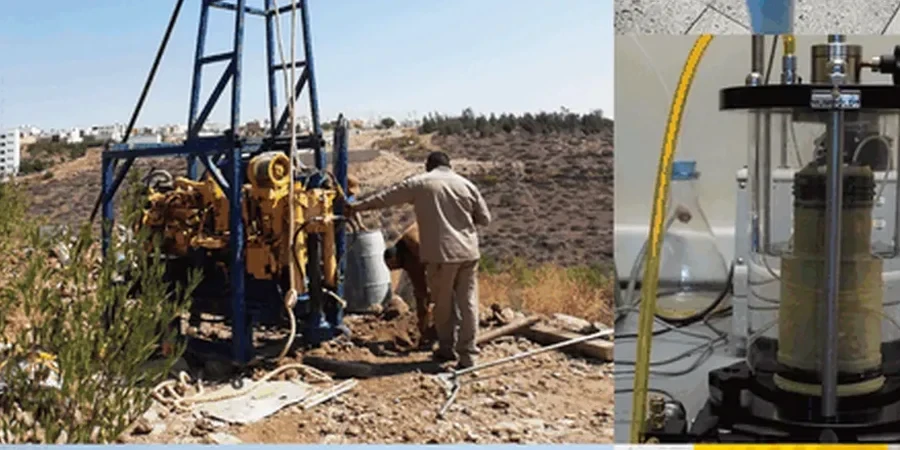
Service characteristics in St. Paul
Working video
Risks and considerations in St. Paul
St. Paul's urban expansion between 1880 and 1930 filled dozens of natural ravines and creek beds that drained toward the Mississippi. Many of these filled areas now underlie residential streets in the West Side and Dayton's Bluff neighborhoods without any engineered compaction records. A soil mechanics study in St. Paul that misses these buried valleys can underestimate differential settlement by a factor of three or more. The Mississippi River bluffs introduce a separate stability concern: oversteepened slopes in glacial till lose cohesion during spring thaw when pore pressures peak in March and April, triggering shallow slumps that have historically damaged retaining structures along Shepard Road and the riverfront parkway. Our consolidation and direct shear testing programs target these exact failure mechanisms, providing the parameters designers need to calculate both magnitude and time-rate of settlement under the proposed structural loads.
Our services
Our St. Paul geotechnical laboratory provides a complete testing program that starts with intact sample extrusion and extends through final reporting. Each phase follows the project-specific testing plan developed during the site investigation stage.
Index Property & Classification Testing
Atterberg limits, grain-size distribution by sieve and hydrometer, moisture content, and organic content determination per ASTM D4318 and D2487. These baseline values establish the soil profile framework for every St. Paul project.
Strength & Consolidation Testing
Unconsolidated-undrained and consolidated-undrained triaxial compression, direct shear on intact and remolded specimens, and one-dimensional consolidation per ASTM D2435. Parameters feed directly into bearing capacity and settlement calculations for footings, mats, and deep foundations.
Rock Core Evaluation
Point-load index, unconfined compression on NQ core, slake durability, and RQD logging. Critical for projects bearing on the Platteville and Glenwood formations that underlie much of downtown and the Capitol complex area.
Common questions
What is included in a soil mechanics study for a St. Paul building permit application?
The City of St. Paul requires a geotechnical report meeting IBC Section 1803 for commercial and multifamily projects. Our study includes field boring logs with SPT N-values, laboratory index and strength testing, groundwater level documentation, and foundation recommendations with allowable bearing pressures and estimated settlements. For sites in the Mississippi River bluff overlay district, slope stability analysis may also be required.
How deep do borings need to go for a typical St. Paul foundation investigation?
Per IBC Table 1803.2, borings must extend through all unsuitable material and at least 10 feet into competent bearing strata. In practice, St. Paul borings on the limestone uplands often reach 30 to 50 feet to penetrate the Decorah Shale into sound Platteville rock. Floodplain sites may require 60 to 80 feet to pass through the alluvial column into glacial till or bedrock.
How much does a soil mechanics study cost in St. Paul?
A comprehensive soil mechanics study in St. Paul typically ranges from US$2,730 to US$5,920, depending on the number of borings, depth to bedrock, and the laboratory testing program required. Floodplain sites with deep alluvium and projects needing rock coring fall toward the upper end of that range.
How long does laboratory testing take after field drilling is complete?
Standard index testing (moisture content, Atterberg limits, sieve analysis) can be reported within 3 to 5 business days. Consolidation and triaxial shear tests require 7 to 14 days due to specimen saturation and slow strain-rate loading protocols. Rock strength testing on core specimens typically adds 5 to 7 days. We schedule the testing sequence so that critical parameters are available before the final report deadline.