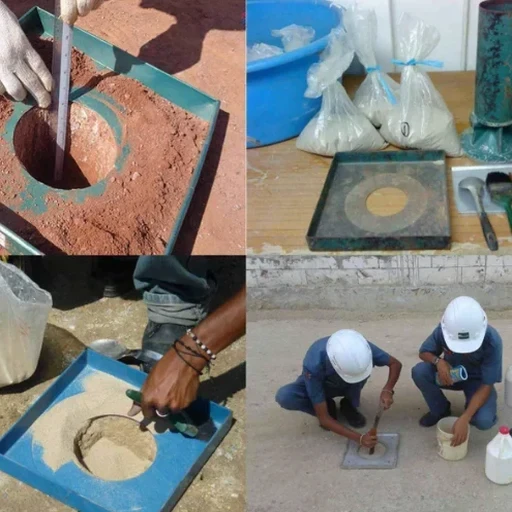
In St. Paul, we often see projects that look perfect on the surface fail because the compaction underneath wasn't properly verified. The glacial till and alluvial deposits along the Mississippi River corridor can be deceptive, and a visual check is never enough. That's why our team relies on the sand cone method per ASTM D1556 to give project managers an accurate, defensible measurement of in-place density. When we work on sites near the bluffs overlooking the river or in the new developments around the old Ford Plant site, the variability of fill materials means you need a method that directly measures density in the field without assumptions. We often pair this test with a grain size analysis when the material gradation is in question, especially where contractors have imported fill from different sources around the Twin Cities metro.
A sand cone test tells you exactly what's in the ground, not what a model thinks should be there. That distinction saves foundations in St. Paul's glacial soils.
Service characteristics in St. Paul
Risks and considerations in St. Paul
The most common mistake we see on St. Paul job sites is contractors running a nuclear gauge on silty-clay fill without proper site calibration, then acting surprised when the sand cone shows a 5% lower density. The sand cone method doesn't lie. It's a direct measurement of volume and mass, and when you're placing fill over the compressible organic silts that sit in old river channels throughout the Midway and Como areas, that difference matters. A failed compaction test caught late means tearing out lifts that were already approved by visual observation. We've been called in to run comparison tests after a nuke gauge gave passing numbers but the pavement started cracking six months later. The cost of proper field density verification is negligible compared to the cost of reconstructing a settled parking lot in January.
Our services
Our field density testing program in St. Paul is built around practical quality control that keeps projects moving. We coordinate directly with site superintendents and earthwork contractors to schedule testing when it matters, not after the fact.
Compaction Verification for Structural Fill
We perform sand cone tests on lift after lift of compacted fill beneath footings and slabs, comparing results to the modified Proctor curve (ASTM D1557) to confirm 95% or 98% compaction as specified by the project geotechnical engineer.
Utility Trench Backfill Testing
Trench backfill in St. Paul's freeze-thaw environment demands proper density to avoid differential settlement. We test utility trenches for public and private work, providing documentation that meets City of St. Paul Public Works requirements.
Pavement Subgrade and Base Course QA
For parking lots and roadway sections, we verify density on subgrade and aggregate base layers before asphalt or concrete placement. This is critical in the variable soils found from the Highland Park moraine down to the floodplain.
Common questions
How much does a sand cone field density test cost in St. Paul?
For projects in St. Paul and the surrounding metro area, a single sand cone density test typically runs between US$90 and US$170 per test point, depending on mobilization distance and the number of tests scheduled per site visit. Larger testing programs with multiple points per day bring the per-test cost down.
How many sand cone tests do I need for my compaction project?
The frequency of testing depends on the project specifications, but we generally follow the IBC requirement of at least one test per 2,500 square feet per lift, or one test for every 150 cubic yards of fill placed. For utility trenches in St. Paul, the city often requires a test every 50 linear feet per lift. We can help you develop a testing schedule that satisfies both the building official and your project budget.
Why use the sand cone method instead of a nuclear density gauge?
The sand cone method gives a direct measurement of density and volume, which means it doesn't require calibration to a specific soil type the way a nuclear gauge does. In St. Paul's glacial soils, which can contain varying amounts of silt, clay, and gravel in the same fill lift, the sand cone avoids errors from chemical composition or moisture interference that can throw off a nuclear reading. That said, nuclear gauges have their place, and we often use both methods on the same project for efficiency, with the sand cone serving as the referee test.