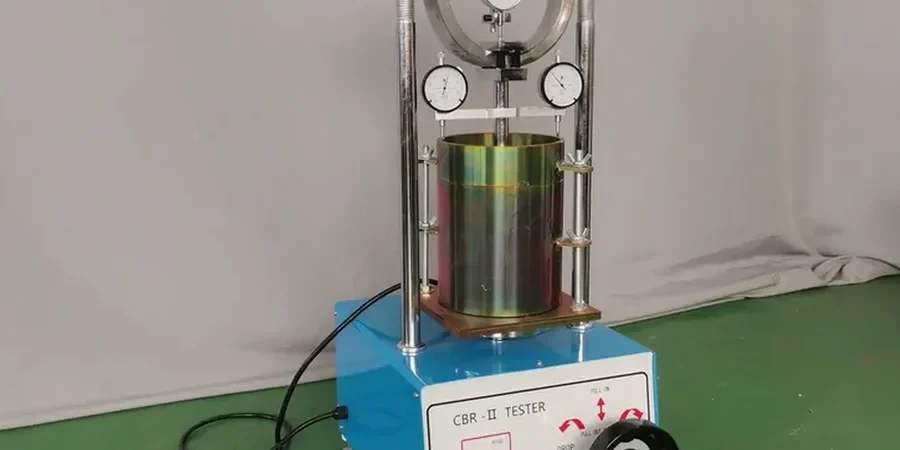
On many St. Paul projects, we encounter glacial till and alluvial silts that look firm during a dry August but lose significant strength once the water table rises or spring thaw saturates the subgrade. The laboratory CBR test quantifies that strength loss by measuring the penetration resistance of a compacted specimen soaked for 96 hours, simulating the worst moisture conditions the pavement base will ever see. Because the Mississippi River valley deposits vary from block to block in neighborhoods like Summit Hill and Frogtown, the soaked CBR value often differs by 3 to 5 points from the unsoaked number, a gap that directly affects aggregate base thickness and ultimately the pavement lifespan. When roadway budgets require precision, we complement the soaked CBR with a grain size analysis to confirm fines content and an Atterberg limits evaluation to understand plasticity, since silty soils with moderate PI tend to produce the most unpredictable CBR results in this part of Ramsey County.
The soaked CBR value, not the field moisture condition at the time of sampling, determines pavement thickness design in St. Paul per MnDOT specification 2105.
Service characteristics in St. Paul
Risks and considerations in St. Paul
St. Paul's freeze-thaw cycle intensity creates a subgrade environment where the CBR value measured in September can misrepresent the soil strength in late March. Frost heave remolds the upper 12 to 18 inches of the formation, temporarily reducing the CBR by 30 to 50 percent until the soil reconsolidates. When a pavement section is designed using an unsoaked or summer-timed CBR number, the aggregate base ends up undersized for the critical spring period, and we start seeing alligator cracking within three to five years instead of the intended fifteen. The Minnesota Department of Transportation requires the soaked CBR value specifically for flexible pavement design per the MnDOT Pavement Manual, and omitting this step in St. Paul—where the frost depth exceeds five feet and the silty subgrades retain water against gravity—is the single most common cause of premature pavement failure we observe in residential subdivision streets and commercial parking lots across the metro area.
Our services
Our St. Paul geotechnical laboratory provides CBR testing as part of a complete pavement subgrade evaluation package. We handle sample collection coordination, moisture conditioning, and reporting calibrated to Minnesota Department of Transportation design inputs.
Soaked Laboratory CBR (AASHTO T 193)
The standard test for flexible pavement design in St. Paul. We compact specimens at optimum moisture, soak for 96 hours with surcharge, and report load-penetration curves with CBR values at 0.1-inch and 0.2-inch penetration. Includes moisture content before and after soaking, dry density, and swell percentage.
CBR with Soil Classification Package
When the subgrade material is variable—common in St. Paul where fill overlies natural river terrace deposits—we pair the CBR test with grain size distribution (AASHTO T 88) and Atterberg limits (AASHTO T 89/T 90) to classify the soil per AASHTO M 145 and flag any unsuitable or highly plastic layers that require subgrade stabilization before paving.
Common questions
What does a laboratory CBR test cost in St. Paul?
A standard soaked CBR test per AASHTO T 193 typically ranges from US$150 to US$190 per point when performed on a remolded specimen. The price depends on whether we are testing a single bulk sample or multiple points across a project, and whether companion tests like Proctor compaction or Atterberg limits are needed.
How many CBR points are needed for a typical St. Paul residential subdivision?
MnDOT and St. Paul city standards generally require one CBR test per distinct soil type encountered, with a minimum of three points for subdivision streets. If the site crosses glacial till and alluvial deposits—as happens frequently in the Highland Park and West Seventh neighborhoods—we recommend at least one point per mapped soil unit to avoid under-design in the weaker zones.
Why is the soaked CBR value more important than the unsoaked value?
The soaked value represents the subgrade strength under saturated conditions, which is the controlling scenario for pavement rutting in St. Paul. Frost melt and spring rain saturate the subgrade from above while the water table rises from below, and the 96-hour soak in the lab simulates that worst-case moisture state. Designing with the unsoaked CBR produces an overly optimistic pavement section that fails early.
How long does it take to get CBR test results?
The soaking period alone is 96 hours, so the full test cycle—including specimen preparation, compaction, soaking, penetration testing, and reporting—takes five to seven business days. We can accommodate expedited requests when project schedules are tight, but the four-day soak is mandatory per AASHTO T 193 and cannot be shortened.
Can you test aggregate base material with the CBR method?
Yes, but the procedure is different. For granular base material, we follow ASTM D1883 with a modified compaction effort and a shorter soaking period, or sometimes skip soaking entirely if the base is free-draining. The result is used to verify that the specified aggregate meets MnDOT Class 5 or Class 6 CBR requirements, typically 80 percent or higher at 0.1-inch penetration.