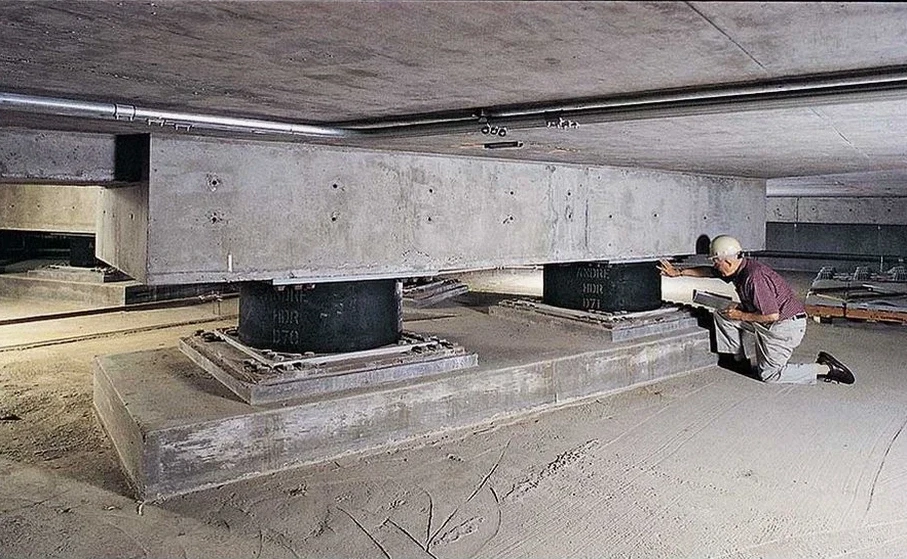
An elastomeric isolator is deceptively simple. A layered sandwich of rubber and thin steel plates. But placing it beneath a building on the soft, post-glacial clays of St. Paul transforms the entire seismic response. The Mississippi River carved a deep valley here, leaving behind compressible alluvium that amplifies ground motion. When we design isolation for a structure near the Science Museum of Minnesota, we are not just dampening acceleration. We are managing long-period displacement on soils that can settle unevenly under cyclic loading. A standard SPT drilling from our crew provides the N-values we need to model that soil-structure interaction accurately. The device itself is a passive mechanical system. No power. No moving parts to seize up when the Mississippi floods and humidity spikes. That is the elegance of the system for St. Paul's climate.
The isolator's performance envelope is defined by the coldest January morning in St. Paul, not just the 2475-year seismic event.
Service characteristics in St. Paul
Risks and considerations in St. Paul
A six-story residential block on West 7th Street. The developer wanted a stiff shear-wall system to save money. The soil report showed 40 feet of compressible clay over limestone. A conventional fixed-base structure would have concentrated drift in the first two floors, risking a soft-story collapse during a New Madrid-type event. Instead, we installed lead-rubber bearings. The building now drifts almost as a rigid block, with the displacement concentrated at the isolation plane. The clay underneath does not degrade because the acceleration transmitted is low. The real risk in St. Paul is not just the shaking. It is long-period basin effects reflecting off the limestone bedrock. These waves get trapped in the sediment, and a base-isolated building must be tuned to avoid resonance with the basin's fundamental frequency.
Our services
The design sequence for a cold-climate isolation project in St. Paul includes specific verification steps not required in warmer regions.
Nonlinear Time-History Analysis
We model the full 3D structure with isolator nonlinearity, using ground motions matched to the St. Paul basin's spectral shape.
Prototype Bearing Testing
Full-scale isolator tests at sub-zero temperatures to verify the design shear modulus and damping before production.
Moat Wall Detailing
Design of thermal breaks and waterproofing for the seismic gap, accounting for 100-year snow loads and frost depth in Minnesota.
Peer Review Support
Technical documentation package for the independent peer review required by ASCE 7 for all isolated structures.
Common questions
What is the typical cost range for base isolation design on a St. Paul mid-rise?
For a full design package including nonlinear analysis and prototype testing, the engineering fee typically ranges from US$4.580 to US$8.620 depending on the structural complexity and the number of unique isolator types.
How does the cold climate affect elastomeric isolators?
Low temperatures cause crystallization in the rubber, temporarily increasing stiffness. We specify a shear modulus adjustment factor based on the minimum basement temperature in St. Paul, and require low-temperature qualification tests per AASHTO modified procedures.
Is base isolation required by code in Minnesota?
It is not mandated for all buildings, but for Risk Category IV structures and taller buildings on Site Class E or F soils in St. Paul, ASCE 7 often makes it the most economical way to meet drift limits without massive shear walls.