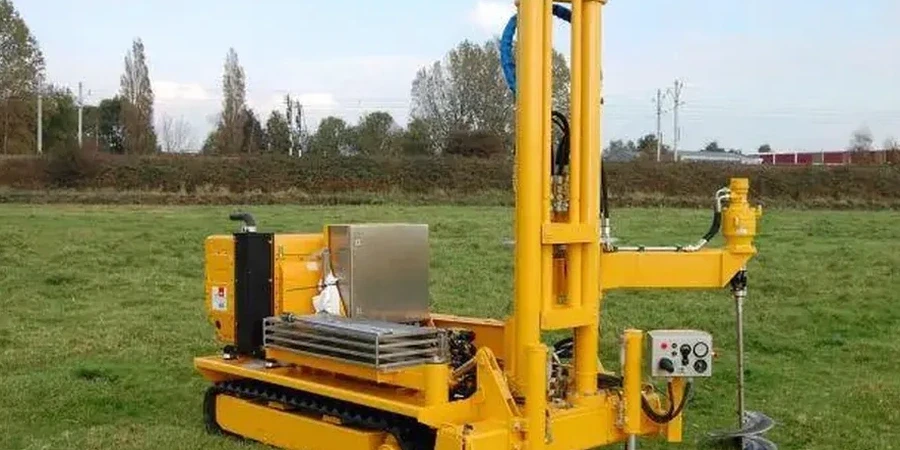
The rig arrives on a tracked carrier, pushing a 15-square-centimeter cone into the ground at a steady two centimeters per second. In St. Paul, our CPT operations typically deploy an electronic friction-cone penetrometer that logs tip resistance, sleeve friction, and dynamic pore pressure simultaneously. The Mississippi River bluffs and glacial outwash plains beneath the city demand this kind of continuous resolution. We run the standard ASTM D5778 procedure, but the local geology—interbedded silts from Lake Agassiz outbursts and dense tills—forces us to adjust push rates often. When the cone hits a gravel lens near the river terraces, the data stream spikes, and that spike tells a story about bearing capacity that no split-spoon sample ever could. For projects near the 44.95 parallel, where winter ground freeze reaches 60 inches, the pore pressure dissipation tests we run become critical for assessing thaw settlement risk before any footing goes in. Complementing this continuous profile with a triaxial test on undisturbed samples helps verify the undrained shear strength derived from the cone data.
A single CPT sounding in St. Paul's glacial outwash can reveal more stratigraphic detail than six borings, especially where thin silt seams control drainage and settlement.
Service characteristics in St. Paul
Risks and considerations in St. Paul
The temperature swings in St. Paul are brutal on electronics. Our cones operate from -20°F winter mornings to 95°F summer afternoons, and thermal drift in the load cell can skew readings if uncorrected. The local stratigraphy presents a different challenge: the Des Moines lobe till is tough and overconsolidated, but it sits on top of much softer St. Peter Sandstone and Decorah Shale in some neighborhoods. A cone refusal at shallow depth might be interpreted as bedrock when it is actually just a boulder in the till—something we verify with pore pressure response. The biggest operational risk is encountering artesian conditions in the buried bedrock valleys near downtown; without real-time pore pressure monitoring during the test, a blowout can develop rapidly and compromise the hole. Our field protocols include immediate dissipation test sequences whenever u2 readings jump unexpectedly, because in St. Paul the water table can be just three feet down or thirty, depending entirely on which glacial terrace you are standing on.
Our services
We deliver CPT data packages ready for engineering analysis, with raw ASCII files, corrected Excel spreadsheets, and plotted profiles in PDF. Our St. Paul field crews handle everything from site access coordination to utility clearance before the first push.
Standard CPT Sounding
Single or multiple cone penetration tests with continuous qc, fs, and u2 recording to depths up to 200 feet. Includes soil behavior type classification.
Piezocone Dissipation Testing
Pore pressure decay monitoring at specified depths to estimate in-situ hydraulic conductivity and equilibrium groundwater conditions.
Seismic CPT (SCPT)
Downhole shear wave velocity measurement integrated with cone penetration, providing Vs profiles for seismic site classification per ASCE 7.
CPT-Logging Correlation Package
Side-by-side comparison of CPT soundings with adjacent SPT borings, calibrated to laboratory index tests from our St. Paul soils lab.
Common questions
What depth can a CPT rig reach in St. Paul soils?
In the glacial tills and outwash deposits common across Ramsey County, our 20-ton tracked rig routinely reaches 100 to 150 feet. In softer floodplain silts along the Mississippi, we have achieved 200 feet. Depth capacity depends on cone refusal criteria—typically when tip resistance exceeds 100 MPa or when rod inclination exceeds 15 degrees. The overconsolidated Des Moines lobe till can cause early refusal in some upland neighborhoods, but we adjust push strategy and use friction reducers when needed.
How much does a CPT test cost in the Twin Cities?
For standard CPT soundings in St. Paul, pricing generally falls between US$150 and US$220 per linear meter, depending on mobilization distance, depth, and whether piezocone or seismic cone modules are required. A typical single-day campaign with three soundings to 60 feet each will reflect mobilization costs spread across the total footage. We carry out a fixed-price proposal after reviewing the site location and target depths.
Is CPT better than SPT for St. Paul projects?
Neither test is universally 'better'—they answer different questions. CPT provides continuous stratigraphic detail and is excellent for detecting thin seams, estimating consolidation parameters, and assessing liquefaction potential in the Mississippi corridor. SPT provides a physical soil sample for visual classification and laboratory testing. On most St. Paul commercial projects, we combine both: CPT for profiling and SPT at key intervals for material verification.
How do you handle frozen ground during winter CPT testing?
Minnesota winters with frost penetration up to 60 inches require pre-drilling through the frozen crust before cone penetration can begin. We use a small-diameter auger or rotary drill to cut through the frozen layer, then insert the cone rods through the pre-drilled hole and begin logging from below the frost line. The frozen zone is logged separately based on the auger cuttings. This adds about 30 to 45 minutes per sounding during January and February jobs.