St. Paul’s topography doesn’t forgive approximation. The city climbs from the Mississippi River floodplain at roughly 210 meters elevation up to glacial till bluffs reaching 270 meters, with slopes exceeding 30 percent in neighborhoods like Dayton’s Bluff and Cherokee Heights. That verticality, combined with a climate that drives 1.5-meter frost depth and spring saturation, makes retaining wall design a geotechnical problem long before it becomes a structural one. Our team works routinely with the Decorah Shale and Platteville limestone formations that underlie much of the city, where differential weathering creates overhang conditions that standard gravity walls cannot handle. When a developer near Summit Avenue needed to hold back 14 vertical feet of silty clay behind a historic property, the solution emerged from test pits logged at three points along the alignment, revealing a buried boulder layer that changed the entire excavation approach. We treat every St. Paul site as a layered puzzle where Pleistocene deposits, weathered bedrock, and urban fill intersect in ways that only local drilling expertise can interpret correctly.
A retaining wall in St. Paul fails most often not from reinforcement rupture, but from water trapped behind the wall during a freeze-thaw cycle that the drainage design didn’t anticipate.
Service characteristics in St. Paul
Risks and considerations in St. Paul
St. Paul’s urban core grew fast between 1880 and 1920, and a lot of that construction filled in ravines and buried streams that no longer appear on any surface map. The old Phalen Creek corridor, now largely culverted, left behind pockets of organic silt and uncontrolled fill that can compress unpredictably under wall footing loads. More than once we’ve uncovered buried timber cribbing or brick rubble at depths of 3 to 5 meters in the North End, material that provides zero lateral support and creates voids when it decomposes. The other risk that catches owners off guard is the interaction between adjacent foundations. St. Paul’s older neighborhoods have shallow-spread footings on neighboring lots that a new retaining wall excavation can undermine if the zone of influence isn’t mapped before digging begins. A pre-construction condition survey combined with a CPT sounding through the suspect fill zone gives us the continuous stratigraphic profile needed to avoid surprises that turn a design-build project into a litigation file.
Our services
Retaining wall design in St. Paul spans residential garden walls under 1 meter to roadway retaining structures exceeding 6 meters. Each project draws on a consistent geotechnical workflow but adapts to the specific site geology and regulatory context.
Segmental Block Walls (MSE)
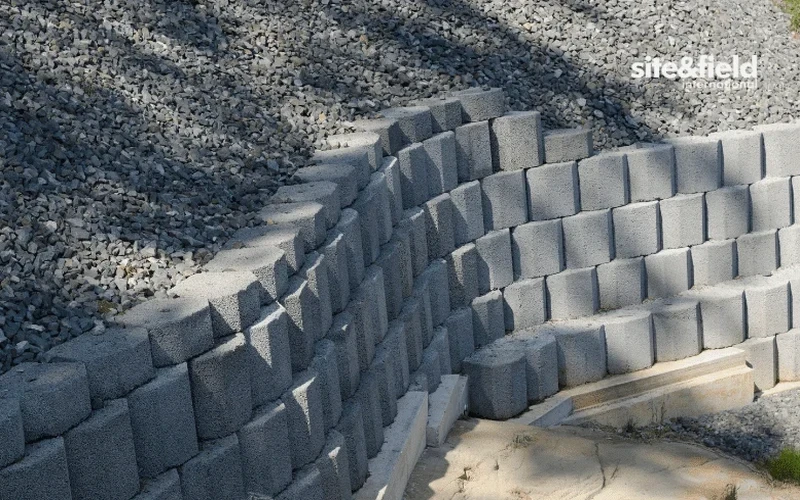
We design mechanically stabilized earth walls with geogrid reinforcement lengths calibrated to the native St. Paul soils behind the reinforced zone. Each design includes global stability verification, pullout capacity checks, and drainage detailing to prevent frost jacking at the facing. Typical applications include residential terracing along West 7th Street slopes and commercial retaining walls in the Midway industrial area.
Cantilever and Counterfort Walls
For sites where the excavation limits restrict geogrid length—common in St. Paul’s dense Summit-University district—we design reinforced concrete cantilever and counterfort walls. Our analysis covers bearing pressure distribution on glacial till, heel sliding resistance, and stem reinforcement for at-rest earth pressure conditions when wall movement is constrained by adjacent structures.
Tieback and Anchored Systems
When retained heights exceed 5 meters and the right-of-way is tight, we specify anchored walls with grouted tiebacks drilled into the Platteville limestone or competent glacial till. Load testing confirms the bond zone capacity, and our design accounts for long-term creep in the clay-rich layers that interbed with the limestone beneath downtown St. Paul.
Common questions
What do retaining wall design services cost in St. Paul?
For a typical St. Paul residential or light commercial retaining wall, design fees range from US$1,170 to US$4,480 depending on wall height, site access constraints, and the number of soil borings required. A simple 1.5-meter segmental wall with good access falls toward the lower end; an 8-meter anchored wall near a property line with multiple borings and global stability modeling approaches the upper end. We carry out a fixed-fee proposal after reviewing the site address and project scope.
Do I need a building permit for a retaining wall in St. Paul?
The City of St. Paul requires a building permit for any retaining wall over 1.2 meters (4 feet) in height, measured from the bottom of the footing to the top of the wall. Walls under that height still need to meet zoning setback requirements. Our design package includes the sealed calculations and construction drawings that the Department of Safety and Inspections (DSI) requires for permit review.
How do freeze-thaw cycles affect retaining wall performance in Minnesota?
Frost action affects retaining walls in St. Paul through two mechanisms: frost heave under the footing if the bearing soil is frost-susceptible silt, and ice lens formation in poorly drained backfill that can push the wall outward. We specify footing depths below the 1.5-meter frost line, use non-frost-susceptible backfill (ASTM D448 No. 57 stone), and detail a continuous drainage system with outlet pipes that daylight above the frost zone to prevent ice blockage.