When we mobilize for an exploratory test pit in St. Paul, we expect to encounter the city’s characteristic glacial drift overlying the St. Peter Sandstone or Decorah Shale, often capped with a complex layer of urban fill along the Mississippi River corridor. Our lab team has opened countless pits in neighborhoods from Summit Hill to the West Side flats, and the variability never ceases to demand attention — one block might expose clean sand with cobbles, while two blocks over, the bucket hits saturated organic silt at four feet. The value of a properly logged test pit lies in that direct visual access, letting our geologists trace lensing, identify buried demolition debris, and collect undisturbed Shelby tube samples before the groundwater starts seeping in. We run field vane shear tests right at the pit wall and correlate the tactile profile with laboratory grain-size distributions to build a depositional model that makes sense of the site.
Direct observation of St. Paul's glacial stratigraphy in a test pit reveals depositional boundaries that no borehole log can capture with the same continuity.
Service characteristics in St. Paul
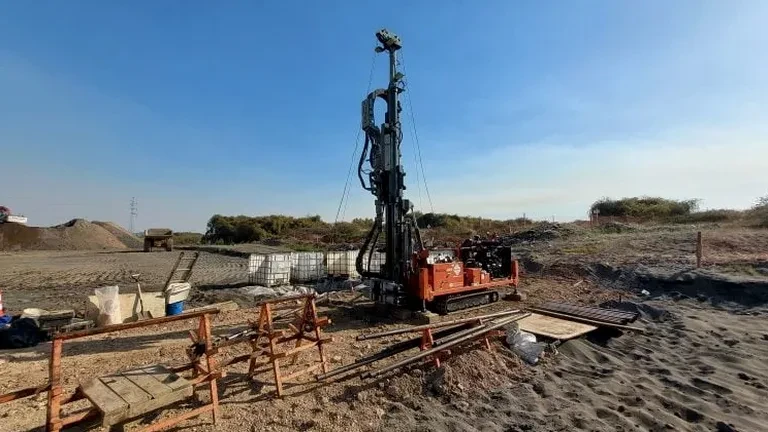
Working video
Risks and considerations in St. Paul
The St. Peter Sandstone formation underlies much of downtown St. Paul at depths ranging from 10 to 40 feet, and its contact with the overlying glacial till creates a perched groundwater condition that surprises many excavation crews. We have seen pits flood within twenty minutes of breaching that interface, especially in the Lowertown district where the regional water table sits consistently high from November through May. Beyond the hydraulic risk, the Decorah Shale that outcrops along the river bluffs weathers rapidly when exposed to air — a pit left open for more than a shift can develop slaking along the walls, compromising the stability of the excavation and obscuring the true stratigraphy. Our field protocols mandate immediate logging and sampling of shale faces, followed by protective covering if the pit must remain open overnight. In fill-dominated sites along University Avenue, the primary hazard is encountering unmarked utilities encased in loose rubble, which is why we coordinate with Gopher State One Call and maintain a buffer zone until positive identification is complete.
Our services
Our exploratory test pit program in St. Paul integrates field logging with laboratory testing to deliver a complete geotechnical profile. The operations below represent the core components we execute on every investigation.
Stratigraphic Logging and Sampling
Continuous photographic documentation of pit walls with detailed logs per ASTM D2487, including Munsell color notation, moisture condition, and consistency. Undisturbed Shelby tube samples and bulk bags are collected at every lithologic change for laboratory classification and strength testing.
In-Situ Density and Strength Verification
Field vane shear tests performed directly on pit walls at one-foot vertical intervals through cohesive strata. For granular layers, we correlate visual density descriptors with adjacent SPT data and run nuclear density gauge checks on compacted backfill during pit closure to match the original ground conditions.
Common questions
What does an exploratory test pit in St. Paul typically cost?
For a standard test pit excavated to depths of 8 to 12 feet in accessible terrain within the St. Paul metro area, the cost generally falls between US$430 and US$720. This range covers the backhoe mobilization, our geologist's time for logging and sampling, field testing, and the basic laboratory classification report. Deeper pits, confined access sites, or pits requiring shoring will push the cost toward the upper end. We carry out a firm quote after reviewing the site plan and confirming underground utility clearances.
How deep can you excavate a test pit in the glacial soils around St. Paul?
With a standard backhoe, we routinely reach 14 feet in the cohesive till that dominates the St. Paul subsurface. Beyond that depth, we bench the excavation or step back the slopes to maintain safe entry conditions. In loose granular zones near the Mississippi River, we may limit depth to 10 feet without shoring, as the sand tends to run at the toe of the slope. Every pit depth is assessed continuously during excavation based on soil behavior and groundwater inflow.
What information does a test pit provide that a boring cannot?
A test pit exposes a continuous vertical face, which lets our geologist observe thin seams, lenses, and structural features like fissures or slickensides that a split-spoon sample misses entirely. We can measure the true dip of bedding planes, photograph the transition between fill and natural ground, and collect large block samples for strength testing. In St. Paul's complex urban fill environments, that visual continuity is what separates a reliable foundation design from one built on incomplete assumptions.