St. Paul sits on a dramatic landscape carved by the Mississippi River, where steep bluffs and deeply incised ravines define neighborhoods from Cherokee Heights to Dayton's Bluff. The local geology stacks Pleistocene glacial till, loess, and alluvium over the St. Peter Sandstone and Platteville limestone, creating a layered profile that is beautiful but notoriously tricky to build on. Our team has spent years working within these formations, and we've learned that slope stability here is never just a textbook exercise — it's about reading the subtle signs of distress that appear after a heavy spring thaw or a summer cloudburst. A test pit investigation in the upper colluvium often reveals moisture conditions that laboratory data alone would miss. The city's 44.9497°N latitude means deep frost penetration in winter, and that freeze-thaw cycling is a primary trigger for shallow slumping in the silty loess that mantles so many St. Paul slopes. Understanding this interaction between climate, stratigraphy, and human activity is what makes a stability analysis genuinely useful for a developer or a homeowner.
In St. Paul, slope stability is driven less by big earthquakes and more by the quiet persistence of water, frost, and time acting on layered glacial deposits.
Service characteristics in St. Paul
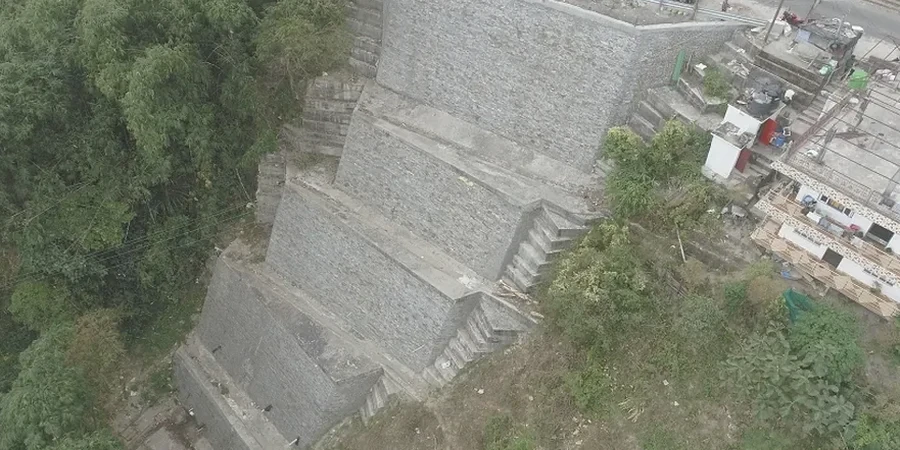
Risks and considerations in St. Paul
Something we see repeatedly in St. Paul is the 'slow creep' failure mode — not a dramatic landslide, but a gradual downslope movement of the weathered loess and colluvium that goes unnoticed until foundation cracks appear or a retaining wall starts tilting. This is especially common on east-facing bluffs where morning sun accelerates thawing of frozen ground, saturating the surface layer while deeper soil remains frozen and impermeable. Water gets trapped at the interface, pore pressures spike, and the slope moves a few millimeters each year. Over a decade, that adds up to real damage. Another classic scenario involves homeowners on bluff-top lots who clear vegetation and add irrigation without realizing they are increasing infiltration into an already marginal slope. Our role is to quantify these risks in terms the client can act on — a factor of safety below 1.1 for a saturated spring condition means mitigation is not optional, it's urgent. We also evaluate the potential for larger rotational failures in the underlying shale units, which, while less frequent, can be catastrophic when they occur.
Our services
Our slope stability work in St. Paul spans from preliminary feasibility assessments for single-family lots to detailed design support for municipal infrastructure along the river corridor. Every project starts with understanding the geologic context and ends with a clear, actionable recommendation.
Bluff & Ravine Stability Evaluation
Comprehensive analysis of natural and cut slopes along St. Paul's river and creek corridors, including LIDAR interpretation, subsurface exploration, and limit-equilibrium modeling under static and seismic conditions.
Development Feasibility on Sloping Sites
Geotechnical assessment for proposed construction on lots with greater than 10% grade, evaluating setback requirements, foundation options, and drainage management to satisfy City of St. Paul building review.
Failure Investigation & Remedial Design
Forensic analysis of existing slope failures, including instrumentation monitoring, back-analysis to calibrate soil parameters, and development of stabilization measures such as tied-back walls, soil nailing, or regrading.
Common questions
What triggers slope instability in St. Paul's bluffs?
The main triggers we see are spring snowmelt and heavy rain events that saturate the upper loess and colluvium layers. When water percolates down to the contact with the underlying limestone or shale, it creates a perched water table that reduces effective stress and shear strength. Freeze-thaw cycles in late winter also contribute by loosening the near-surface soil fabric.
How do you determine if my lot is safe to build on?
We start with a site reconnaissance and review of available geologic maps and LIDAR data, then plan a subsurface investigation with borings or test pits to define the soil and rock profile. Samples are tested for shear strength parameters, and we model the slope under both dry and saturated conditions. The City of St. Paul typically requires a factor of safety of at least 1.5 for static conditions before approving construction near a bluff or steep slope.
What is the typical cost for a slope stability analysis in Ramsey County?
For a residential or small commercial site in St. Paul, a complete slope stability evaluation generally ranges from US$1,300 to US$4,430 depending on the extent of drilling, laboratory testing, and the complexity of the slope geometry. Sites with multiple slope aspects or requiring instrumentation will be at the higher end.
Does St. Paul require seismic slope stability analysis?
While Minnesota is a low-seismicity region, the IBC and ASCE 7 still require consideration of seismic effects for critical structures or slopes with a factor of safety near the threshold. We typically evaluate a pseudostatic condition with a horizontal acceleration of 0.04-0.06g, which rarely governs the design but provides a complete picture of slope performance.