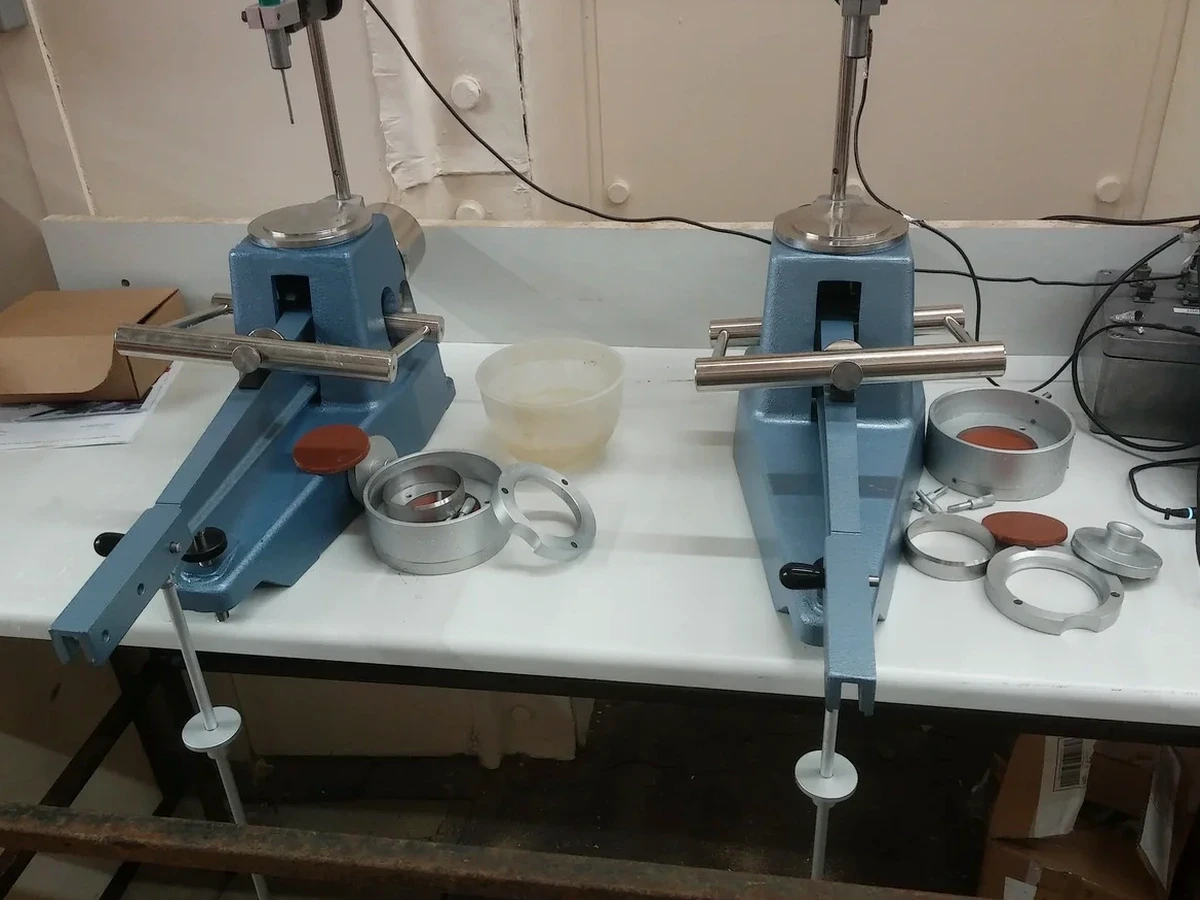
In St. Paul, the winter freeze-thaw cycles and the thick deposits of glacial lake sediment along the Mississippi River bluffs create a particular sensitivity to soil moisture. We routinely see projects delayed because the field crew misjudged the silt content in what looked like a stable clay. Atterberg limits testing defines that boundary precisely — the moisture content where a soil stops behaving like a solid and starts flowing, or where it crumbles when remolded. Our lab runs these tests under ASTM D4318, and we correlate the results with the USCS classification per ASTM D2487. For sites near the river or in the Summit Hill area where reworked loess is common, knowing the liquid limit and plasticity index before excavation is not a formality. It determines whether the native material can be reused as structural fill or must be undercut and replaced. We often pair this with grain-size analysis to separate the silt and clay fractions that control the soil’s reactivity.
A plasticity index above 20 in St. Paul’s glacial silts signals a soil that will move with every rainstorm — designing for it upfront costs far less than repairing a cracked slab later.
Service characteristics in St. Paul
Risks and considerations in St. Paul
The mistake we see too often in the Twin Cities is a contractor classifying a soil as ‘clayey sand’ from a visual inspection and then placing it as backfill against a basement wall. If the fines fraction has a liquid limit over 40 and a plasticity index above 15, that soil will expand laterally when saturated after the first spring melt. In St. Paul, where frost depth reaches 60 inches per the Minnesota building code, the moisture migration during freeze-thaw cycles concentrates water in the fine-grained lenses. Without an Atterberg limits test, the difference between a CH fat clay and an ML silt is invisible to the naked eye, but the structural consequence is not. Foundation walls can rotate, slab-on-grade floors can heave, and pavement subgrades can lose stiffness within two seasons. The cost of a couple of lab tests is trivial next to the cost of excavating and replacing 800 cubic yards of failed fill.
Our services
The Atterberg limits test is one component of a broader laboratory suite we run for St. Paul projects. These two complementary operations are typically requested alongside the standard classification package.
Atterberg Limits with USCS Classification
Complete liquid limit and plastic limit determination under ASTM D4318, with the soil classified per ASTM D2487. Includes moisture content per ASTM D2216 and a written summary of the soil’s expected behavior for the engineer of record.
Correlative Grain-Size and Hydrometer Analysis
For soils where the silt-versus-clay fraction matters for frost susceptibility, we run a full sieve and hydrometer test (ASTM D7928/D422) and pair it with the Atterberg results to assign the correct USCS group symbol.
Common questions
How much does an Atterberg limits test cost for a St. Paul residential project?
A standard Atterberg limits test on a single sample runs between US$60 and US$90. The final cost depends on how many samples you need and whether you also request a grain-size distribution or a full soil classification report. For a typical residential foundation investigation with three samples, the lab fee is modest compared to the overall geotechnical package.
How long does it take to get the results back from the laboratory?
Routine turnaround is three to four business days once the sample arrives at the lab. The oven-drying step for moisture content alone takes 16 to 24 hours. If the project is on a tight schedule, we can expedite to 24 hours for a surcharge, provided the sample is delivered before 10 a.m.
Can you run the test on samples that have already dried out?
No — ASTM D4318 requires the test to start from a wet-prepared condition, not from dry soil that has been reconstituted with water. Drying the sample beforehand changes the clay mineral structure and produces a lower liquid limit. For St. Paul field work, we supply airtight jars to the drill crew so the samples stay at their natural moisture content until they reach the lab.