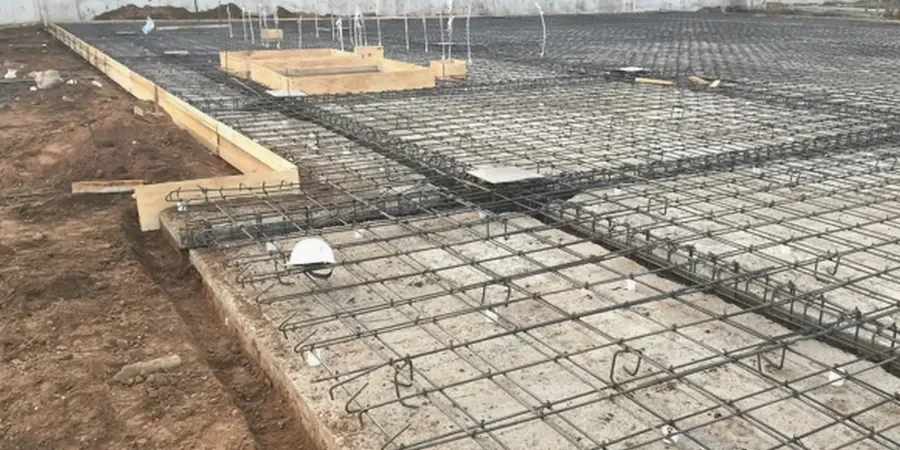
St. Paul sits at roughly 702 feet above sea level, draped over the deeply cut valley of the Mississippi River. That elevation change matters when you're placing a large building on glacial till and lacustrine clays. A conventional spread footing works on the limestone uplands near Summit Avenue, but down by the river flats, the compressible layer can exceed 40 feet. A rigid raft foundation bridges those soft spots. The design distributes column loads across the entire footprint, cutting differential settlement to a fraction of an inch. The engineering team runs the numbers directly against the frost depth requirements in the Minnesota State Building Code and the bearing capacity adjustments in IBC Chapter 18. Before finalizing the mat thickness, it is common to run a CPT test to map the exact depth of the dense till, especially where old buried channels cross the site.
The difference between a successful mat foundation in St. Paul and a problematic one is knowing the exact thickness of the compressible lake clay before the first yard of concrete is poured.
Service characteristics in St. Paul
Risks and considerations in St. Paul
About 10,000 years ago, Glacial River Warren carved the Mississippi gorge through St. Paul. That left behind a messy stratigraphy: stiff glacial till on the uplands, but deep, normally consolidated silty clays in the old river terraces. The water table in downtown St. Paul often sits just 8 to 15 feet below grade. A raft foundation here fights two battles. First, long-term consolidation settlement under sustained dead load. Second, short-term cyclic degradation if the clay has sensitivity above 4. The biggest structural threat is angular distortion between the elevator core and the perimeter columns. The design counters this with a thicker slab section under the core and a rigorous consolidation analysis using laboratory-derived Cv and Cc values. Ignoring the perched groundwater in the alluvial sands would be a mistake; buoyancy checks and sub-slab drainage become mandatory.
Our services
The scope adapts to the specific challenges of the Twin Cities geology. The work starts with a geotechnical investigation and ends with a stamped structural drawing set.
Geotechnical Investigation & Parameter Derivation
Drilling through St. Paul's glacial stratigraphy to sample the Decorah Shale, Platteville limestone, and overlying till. We run consolidation and triaxial tests to supply the design team with accurate modulus of subgrade reaction (ks) values and settlement parameters.
Structural Mat Design & FEM Analysis
Full structural design of the raft slab including punching shear checks at columns, flexural reinforcement layout, and soil-structure interaction modeling using finite element software. The output is a complete calculation package and construction drawings sealed by a licensed professional engineer in Minnesota.
Common questions
What is the typical cost for a mat foundation design in St. Paul?
For a typical commercial building in the 5,000 to 15,000 square foot range, the engineering fee for a full geotechnical investigation and structural mat design generally runs between US$1,060 and US$3,890. The final number depends on the number of borings required and the complexity of the structural analysis.
How does the frost depth affect the raft design?
Minnesota requires a 60-inch frost protection depth. For a heated building, a mat foundation can be placed at a shallower depth, typically 24 to 36 inches below grade, because the building heat loss prevents freezing directly under the slab. The perimeter must still be insulated vertically to meet the code.
What is the biggest risk when building on St. Paul's clays?
The main risk is differential settlement due to the variable thickness of the compressible lake clays. A rigid mat mitigates this by redistributing loads, but you still need to break the settlement analysis into multiple sections if the clay layer thickness varies by more than 20 percent across the footprint.
Do you need pile support for a raft in St. Paul?
Not usually. In most of St. Paul, the glacial till at depth provides adequate bearing for a properly designed mat. Piled rafts are only needed for very tall or heavy structures where the upper clays are too soft to control settlement with a mat alone.