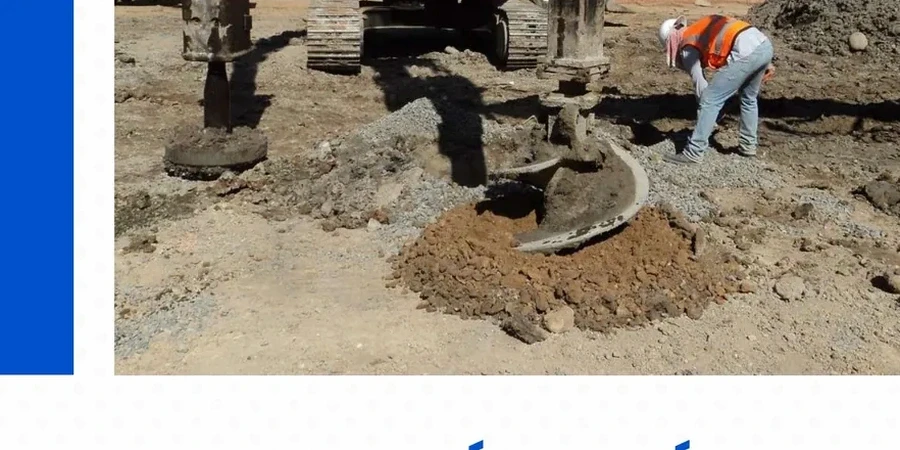
The vibroflot penetrates the soft ground under its own weight, aided by water jets and compressed air. In St. Paul, the challenge is the deep, compressible alluvium deposited by the Mississippi River over glacial lake sediments. These soils, often soft clays and loose silty sands, need ground improvement that conventional footings cannot carry out alone. Our team designs stone column arrays that densify the surrounding soil while creating stiff, load-bearing vertical drains. We specify aggregate gradation per ASTM D2487 and verify target densification through post-installation CPT soundings. The design accounts for the city's specific seismic demands under the IBC, ensuring that the improved ground performs reliably during both static loading and the region's occasional low-to-moderate seismicity.
A well-designed stone column transfers load through arching, turning a compressible stratum into a composite block with three times the native stiffness.
Service characteristics in St. Paul
Risks and considerations in St. Paul
St. Paul's expansion eastward from the riverfront in the late 19th century buried old stream channels and filled ravines with uncontrolled debris. Today, those areas present a hidden risk of differential settlement that standard site investigations often miss. Stone column design in these variable fills requires a detailed review of historical maps and utility archives. The real danger is assuming uniform soil conditions across a site—when old buried valleys or organic lenses exist, columns can lose confinement and bulge laterally. We correlate borehole logs with SPT drilling data to identify these anomalies before designing the grid. A poorly informed layout can lead to tilting slabs and cracked utilities within the first five years of service, a costly outcome in a city with a building stock as old as St. Paul's.
Our services
Our stone column design package for St. Paul sites covers everything from feasibility assessment to installation QA/QC. We define the column grid, depth, aggregate spec, and acceptance criteria based on the specific subsurface profile.
Vibro-Replacement Design Package
Full design of dry bottom-feed or wet top-feed stone columns including area replacement ratio calculations, settlement analysis using the Priebe method, and liquefaction mitigation checks for loose saturated sands. Delivered with construction-ready installation plans and aggregate specifications.
Post-Installation Verification Testing
Quality control program using CPT soundings and full-scale modulus load tests on individual columns. We compare the achieved composite shear wave velocity against design targets to confirm lateral confinement and drainage performance.
Common questions
How long does a stone column design for a typical St. Paul commercial lot take?
Design for a standard 30,000 sq ft commercial lot in St. Paul usually takes 10 to 14 business days after receiving the final geotechnical report. The timeline depends on how many column load tests and CPT correlations we need to run to calibrate the settlement model for the specific alluvial deposits on site.
What is the expected cost range for stone column design services in St. Paul?
The design fee ranges from US$1,660 to US$5,160, depending on the treated area, number of column types, and whether liquefaction mitigation checks are required. This covers the calculation package, installation specs, and one round of construction support. Verification testing is quoted separately.
Do stone columns work in the organic silts found near the Mississippi River in St. Paul?
Stone columns need lateral confinement to function. In very soft organic silts with undrained shear strength below 15 kPa, we often modify the design to use a geotextile-encased column or switch to rigid inclusions. Our feasibility analysis measures the critical shear strength threshold during the site investigation phase.
What standard does your team use to calculate settlement reduction?
We use the Priebe method as the primary analytical model, which calculates the improvement factor based on the area replacement ratio and the friction angle of the stone. For irregular grids or layered profiles, we validate the results with axisymmetric finite element models to capture bulging depth and stress concentration precisely.
How do you account for frost depth in St. Paul stone column designs?
St. Paul's frost depth reaches 60 inches per IBC. We design the upper portion of every column to withstand lateral frost jacking pressures, typically by increasing the area replacement ratio in the top 5 to 6 feet and using clean, angular aggregate that drains freely, preventing ice lens formation around the column head.