St. Paul's growth along the Mississippi River bluffs created a landscape where geology dictates every foundation decision. From the early limestone quarries that built Summit Avenue's Victorian mansions to the modern infill projects in the West 7th neighborhood, the soil profile varies dramatically within a few blocks. The city sits atop layers of glacial till, alluvial deposits, and the underlying Platteville limestone, which means effective stress parameters can change abruptly at depth. When projects push beyond shallow footings, the triaxial test becomes essential for determining drained and undrained shear strength under controlled conditions. We run these programs in our accredited laboratory, following ASTM D4767 for consolidated-undrained testing with pore pressure measurement and ASTM D2850 for unconsolidated-undrained quick checks on cohesive samples. The resulting friction angles and cohesion intercepts feed directly into bearing capacity equations and slope stability models that must account for the Mississippi River valley's complex stratigraphy.
In St. Paul's glacial till, triaxial-derived drained friction angles typically range from 32 to 38 degrees, but the cohesion intercept can drop to near zero if silt seams are present.
Service characteristics in St. Paul
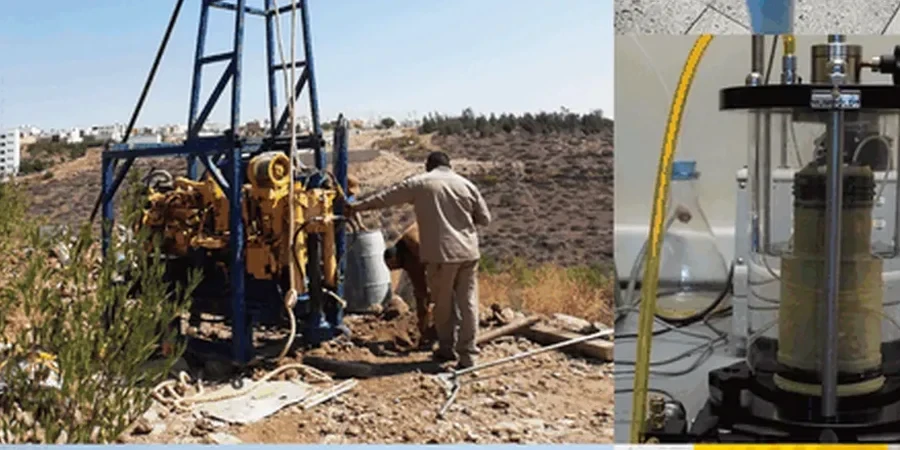
Risks and considerations in St. Paul
The most common mistake we see on St. Paul projects is using total stress parameters from unconsolidated-undrained tests for long-term slope stability analysis. Along the river bluffs, a 60-foot cut analyzed with φ=0 and undrained shear strength may show an acceptable factor of safety during construction, but the same slope can fail years later as pore pressures equilibrate and the soil shifts toward drained behavior. The December 2016 landslide below the University of St. Thomas campus, though triggered by heavy rain, highlighted how progressive softening in the Decorah shale reduces strength below the peak values measured in quick tests. A proper triaxial program measures the effective stress envelope so the geotechnical engineer can model both short-term and long-term conditions. We also see contractors skip consolidation stages entirely, ending up with friction angles that overestimate the soil's actual drained strength by 4 to 7 degrees—enough to undersize footings on the silty sands common in the Midway area.
Our services
Our St. Paul laboratory supports triaxial programs with the sample preparation and data reporting needed for local design challenges:
Multi-Stage Triaxial Testing
Instead of three separate specimens, we shear a single sample at increasing confining pressures. This reduces material variability and works well for the stiff glacial tills beneath St. Paul where Shelby tube recovery can be inconsistent. We report the full Mohr-Coulomb envelope with statistical confidence intervals.
Triaxial with Bender Elements
We embed piezoelectric bender elements in the triaxial pedestal to measure shear wave velocity (Vs) during consolidation. This gives a direct small-strain shear modulus (Gmax) that pairs with the large-strain friction angle from the shear stage—useful for seismic site response modeling required under the IBC for St. Paul's Site Class D profiles.
Common questions
What does a triaxial test cost for a St. Paul project?
A standard three-specimen consolidated-undrained triaxial program with pore pressure measurement runs between US$1,700 and US$2,840, depending on sample condition and the number of confining stages. Unconsolidated-undrained quick tests fall at the lower end of that range. The final figure depends on whether we need to trim Shelby tube samples, run consolidation stages to verify t100, or add saturation back-pressure cycles for stiff clays.
How do you select the confining pressures for the triaxial specimens?
We calculate the effective overburden pressure at the sample depth using the boring log's unit weight profile and the groundwater level recorded during drilling. The three confining pressures typically bracket that value: one near the in-situ stress, one lower, and one higher. For a sample from 25 feet deep in St. Paul's glacial till with the water table at 10 feet, the effective vertical stress is roughly 1,200 psf, so we might run confinements at 800, 1,200, and 1,600 psf. This spread produces a Mohr-Coulomb envelope that captures the strength behavior across the stress range relevant to the foundation or slope design.
What distinguishes a triaxial test from a direct shear test?
The triaxial cell controls drainage and measures pore water pressure throughout the test, which a direct shear box cannot do reliably. For St. Paul's saturated silty clays, that pore pressure measurement is critical because it separates total stress from effective stress. The failure plane in a triaxial test develops naturally along the weakest orientation rather than being forced on a horizontal plane as in direct shear. This matters when bedding planes or silt seams in the glacial deposits create anisotropic strength. We also get the full stress-strain curve and can calculate the secant modulus at any strain level, which feeds into finite element models for deep excavations. More info.